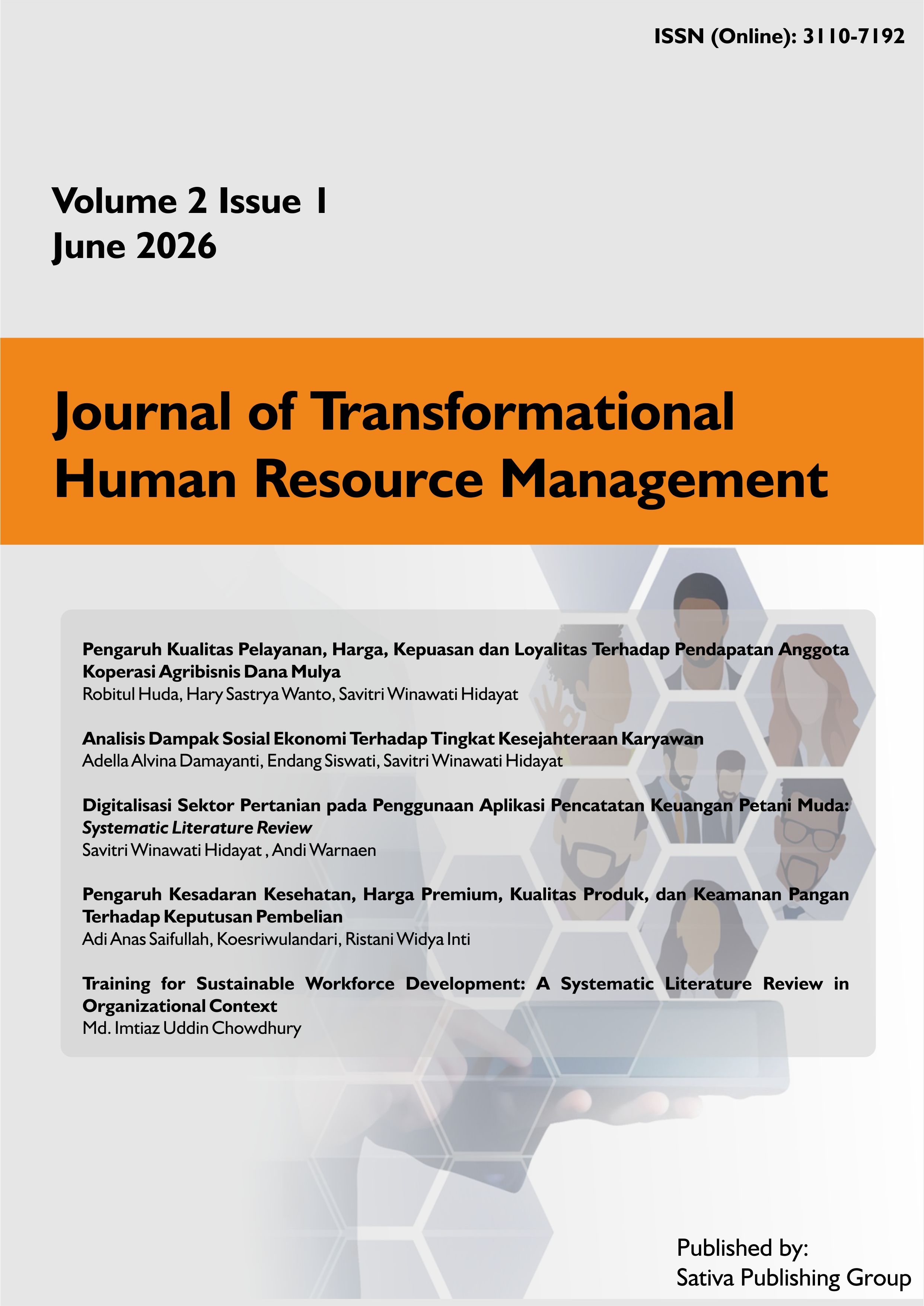
Training for Sustainable Workforce Development: A Systematic Literature Review in Organizational Context
DOI:
https://doi.org/10.64118/jthrm.v2i1.146Keywords:
Human Capital, Sustainable Workforce, Training, Organizational PerformanceAbstract
The paper “Training for Sustainable Workforce Development: A Systematic Literature Review in Organizational Context” aims to enhance the performance of an organization by reducing the disengagement of employees in departmental works. Training and development are integral to the creation and maintenance of a sustainable workforce. In today’s dynamic organizational environments, sustainability is not limited to environmental concerns; it also encompasses the long-term viability of human capital. This article explores the importance of training in promoting sustainable workforce development. It discuss on the materialistic application of different scholars’ theories of concern issues for sustainable workforce development. There have tried to make coherent the theories for SWD in organizational contexts. The paper concludes by offering strategic recommendations for integrating sustainability-oriented training programs in modern organizations. Consequently this environment uplifted management/employees skills that accelerating the organizational performance as well as establish a brand.
Downloads
References
Akinyele, S. T. (2007). The Impacts of Nigerian Training Programmes on Employees Performance. Research Journal of Business Management, 1(1), 11-19.
Alba-Ramirez, A., & Blazquez, M. (2003). Types of job match, over education and labour mobility in Spain. In: Buchel, F., Grip, A. and Mertens, A. (Eds.). Overeducation in Europe: Current Issues in Theory and Policy, 65.
Aldridge, E. (2023). Leadership Training for Employees: What Are the Benefits?. https://educate360.com/blog/leadership-training-for-employees/.
Allianz Partners. (2023). Sustainable Global HRM Practices. https://www.allianzcare.com/en/employers/business-hub/hr-blogs/sustainable-global-hrm-practices.html.
Anwar, G., & Shukur, I. (2015). The Impact of Training and Development on Job Satisfaction: A Case Study of Private Banks in Erbil. International Journal of Social Sciences & Educational Studies, 2(1), 73-80.
Argyris, C. (1996). Organizational Learning II: Theory, Method, and Practice (2nd ed.). Addition-Wesley. http://www.worldcat.org/oclc/56225478.
Armstrong, M. (2007). Řízení lidských zdrojů. Grada publishing as.
Asfaw, A. M., Argaw, M. D., & Bayissa, L. (2015). The Impact of Training and Development on Employee Performance and Effectiveness: A Case Study of District Five Administration Office, Bole Sub-City, Addis Ababa, Ethiopia. Journal of Human Resource and Sustainability Studies, 3(04), 188.
Bae, S. O., & Patterson, L. (2013). The Effect of Corporate Investment in Human Capital on Employee's Performance: Major Korean Financial Corporation Examined. Academy of Strategic Management Journal, 12(2), 55.
Ballot, G., Fakhfakh, F., & Taymaz, E. (2006). Who Benefits from Training and R&D, the Firm or the Workers?. British Journal of Industrial Relations, 44(3), 473-495.
Bartel, A. P. (2000). Measuring the Employer's Return on Investments in Training: Evidence from the Literature. Industrial Relations: a Journal of Economy and Society, 39(3), 502-524.
Becker, G. S. (1962). Investment in Human Capital: A Theoretical Analysis. Journal of political Economy, 70(5), 9-49.
Becker, G. S. (1964), Human Capital: A Theoretical and Empirical Analysis with Special Reference to Education, First Edition. NBER. https://www.nber.org/books-and-chapters/human-capital-theoretical-and-empirical-analysis-special-reference-education-first-edition.
Becker, G. S. (1989). Human Capital: A Theoretical and Empirical Analysis, with Special Reference to Education. University of Chicago Press.
Bishop, J. H. (1994). The Impact of Previous Training in Schools and on Jobs on Productivity, Required OJT, and Turnover of New Hires. Private Sector and Skill Formation: International Comparisons, edited by Lisa Lynch, National Bureau of Economic Research, Chicago: Univ. of Chicago Press.
Black, S. E., & Lynch, L. M. (1995). Beyond the Incidence of Training: Evidence from a National Employers Survey. National Bureau of Economic Research.
Campbell, J. P. (1971). Personnel Training and Development. Annual Review of Psychology, 22 (1): 565–602.
Chiva, R., Ghauri, P., & Alegre, J. (2014). Organizational Learning, Innovation and Internationalization: A Complex System Model. British journal of management, 25(4), 687-705.
Daniel, C. O. (2018). Effects of Training on Organizational Performance. Asian Journal of Business and Management, 6(5), 21-28.
Daniëls, E., Muyters, G., & Hondeghem, A. (2021). Leadership Training and Organizational Learning Climate: Measuring Influences Based on A Field Experiment in Education. International journal of training and development, 25(1), 43-59.
Dearden, L., Reed, H., & Van Reenen, J. (2006). The Impact of Training on Productivity and Wages: Evidence from British Panel Data. Oxford Bulletin of Economic and Social Research, 68(4), 397-421.
Dewey, A. & Drahota, A. (2016). Introduction to Systematic Reviews: Online Learning Module Cochrane Training, https://training.cochrane.org/interactivelearning/module-1-introduction-conducting-systematic-reviews.
Dierdorff, E. C., & Ellington, J. K. (2017). Chapter 17: Team Training (Knowing Much, but Needing to Know Much More). Cambridge University Press.
Ehnert, I., Parsa, S., Roper, I., Wagner, M., & Muller-Camen, M. (2016). Reporting on Sustainability and HRM: A Comparative Study of Sustainability Reporting Practices by the World's Largest Companies. The International Journal of Human Resource Management, 27(1), 88-108. https://doi.org/10.1080/09585192.2015.1024157.
Elnaga, A., & Imran, A. (2013). The Effect of Training on Employee Performance. European Journal of Business and Management, 5(4), 137-147.
Falola, H. O., Osibanjo, A. O., & Ojo, S. I. (2014). Effectiveness of Training and Development on Employees’ Performance and Organisation Competitiveness in the Nigerian Banking Industry. Bulletin of the Transilvania University of Braşov, 7(1), 161-170.
Fegade, T., & Sharma, P. (2023). Exploring the Impact of Employee Training and Development on Organizational Efficiency and Effectiveness-A Systematic Literature Review. IOSR Journal of Business and Management, 25(4), 56-63.
Garcia, A. (2024). Team Training: Definition, Benefits, and Best Practices. https://training.safetyculture.com/blog/team-training/.
Garvin D. A. (1993). Building a Learning Organization. Harvard Business Review. https://hbr.org/1993/07/building-a-learning-organization.
Gerpe, M. R. (2026). Employee Training. https://www.docebo.com/learning-network/blog/employee-training/.
Gryshuk, R. (2025). Technical Training: Definition, Types, and Program Creation. Corporate training. https://www.educate-me.co/blog/technical-training.
Gupta, D. (2025). 14 Types of Employee Training Programs (+Benefits, Examples). Whatfix. https://whatfix.com/blog/types-employee-training-programs/.
Hemphill, H. & Haines, R. (1997): Discrimination, Harassment, and the Failure of Diversity Training: What to do now. Westport, CT: Quorum.
Hughey, A. W., & Mussnug, K. J. (1997). Designing Effective Employee Training Programmes. Training for Quality, 5(2), 52-57.
Jurnalita, A. C., Nisa, N. F., & Darmastuti, I. (2024). The Role of Employee Training and Development in Supporting Sustainable Economic Growth in Indonesia: Literature Review. Research Horizon, 4(6), 175-182.
Keenan, M. (2023). What is Organizational Learning Theory?. WORKRAMP. https://www.workramp.com/blog/what-is-organizational-learning-theory.
Kuhlman, T., & Farrington, J. (2010). What is Sustainability?. Sustainability, 2(11), 3436-3448.
Lai, Y., & Kleiner, B. H. (2001). How to Conduct Diversity Training Effectively. Equal Opportunities International, 20(5-6-7), 14-18.
Longnecker, C. & Fink, L. S. (2005). Management Training: Benefits and Lost Opportunities. Industrial and Commercial Training, 37(1), 25-30.
Manzoor, F., Wei, L., Bányai, T., Nurunnabi, M., & Subhan, Q. A. (2019). An Examination of Sustainable HRM Practices on Job Performance: An Application of Training as a Moderator. Sustainability, 11(8), 2263. https://doi.org/10.3390/su11082263.
Milhem, W., Abushamsieh, K., & Pérez Aróstegui, M. N. (2014). Training Strategies, Theories and Types. Journal of Accounting, Business & Management, 21(1), 12-26.
Pendry, L. F., Driscoll, D. M., & Field, S. C. (2007). Diversity Training: Putting Theory into Practice. Journal of Occupational and Organizational Psychology, 80(1), 27-50.
Raheja, K. (2015). Methods of Training and Development. Innovative Journal of Business and Management, 4(2), 35–41.
Ramkrishna, S. (2025). What is Employee Training & Development?. Alp Consulting Ltd. https://alp.consulting/what-is-employee-training-and-devlopment/#Training_and_Development_Strategies_for_Employee_Growth.
Ross, S. (2025). Human Capital Theory: Key to Workforce Productivity and Business Success. https://www.investopedia.com/ask/answers/032715/what-human-capital-and-how-it-used.asp#citation-5.
Schultz, M. (2025). What Is Sales Training?. Rain Group. https://www.rainsalestraining.com/blog/what-is-sales-training.
Smart Training, (2024). Digitalize Your Employee Training Program in 6 Easy Steps. https://smartraining.online/digitalize-your-employee-training-program-in-6-easy-steps/.
Sothy, C. H. H. Y. (2019). The Impact of Training and Development on Employee Performance: A Case Study of Selected Private Secondary Schools in Phnom Penh Cambodia. Global Journal of Human Resource Management, 7(3), 40-49.
Sudhakar, R., & Basariya, S. R. (2017). Perspectives and the Factors Influencing Effectiveness of Training and Development on Employees’ Performance. International Journal of Civil Engineering and Technology, 8(9), 135-141.
Sweetland, S. R. (1996). Human Capital Theory: Foundations of a Field of Inquiry. Review of Educational Research, 66(3), 341-359.
Templeton, G. F., Lewis, B. R., & Snyder, C. A. (2002). Development of a Measure for the Organizational Learning Construct. Journal of management information systems, 19(2), 175-218.
Tenney, M. (2024). Inspire Greatness: How to Motivate Employees with a Simple, Repeatable, Scalable Process. BenBella Books.
Verhaest, D. & Omey, E. (2004). The Impact of over Education and its Measurement. Working Papers of Faculty of Economics and Business Administration. Belgium: Ghent University
William Handley, W. (1997). Industrial Safety Handbook. McG RAW-HILL Publishing Company Limited.
Yoder, D. (1942). Personnel Management and Industrial Relations. New York: Prentice-Hall, Inc. Retrieved from http://dx.doi.org/10.1037/13581-000.
Downloads
Published
Issue
Section
License
Copyright (c) 2026 Md. Imtiaz Uddin Chowdhury (Author)

This work is licensed under a Creative Commons Attribution 4.0 International License.